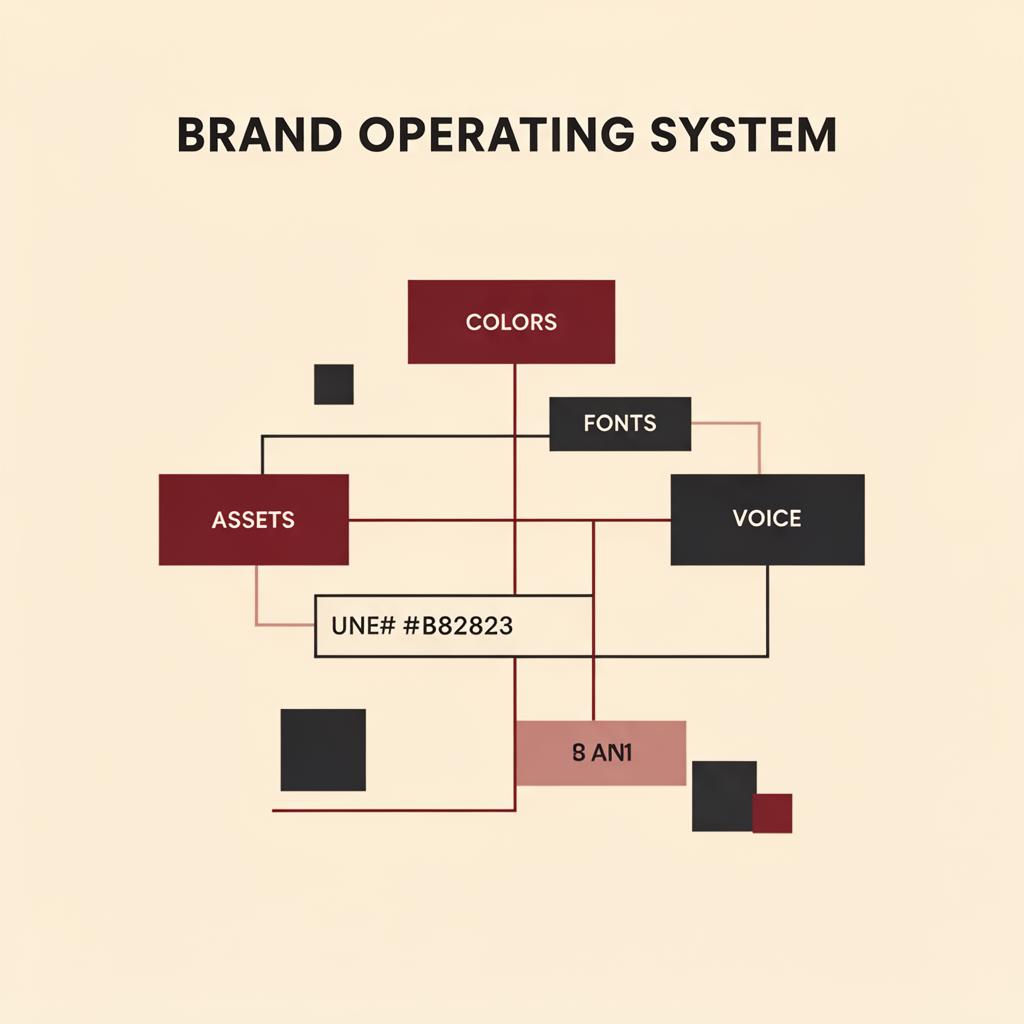
The next layer of marketing infrastructure isn’t another tool. It’s the system that makes all the tools work together.
TL;DR: A Brand Operating System (BOS) is an integrated platform that combines AI capabilities, brand memory, and workflow automation into a single system where marketing teams create, manage, and scale their output — with brand consistency enforced by architecture, not willpower. It’s the infrastructure layer that sits between your strategy and your execution.
Every Era of Marketing Gets the Infrastructure It Deserves
Let’s start with a pattern that’s been repeating for forty years.
In the 1980s, marketing teams kept customer information in Rolodexes, file cabinets, and the heads of salespeople who might leave on Friday. The “system” was institutional memory held by individuals. When those individuals left, the knowledge left with them.
Then someone asked: what if all that information lived in one place? That question created the CRM — and Salesforce turned it into a category worth hundreds of billions of dollars. They didn’t just build a product. They defined an architectural layer that every serious business eventually adopted.
A decade later, the same thing happened with marketing execution. Email, social, ads, and analytics were all separate tools with separate logins, separate data, and separate bills. Then HubSpot, Marketo, and others said: what if all your marketing channels connected to one platform? That question created Marketing Automation — and later, the Marketing Cloud.
Each of these transitions followed the same arc. First, the tools proliferate. Then the tools create chaos. Then someone builds the system that connects them. The tools don’t disappear — they get absorbed into something bigger.
We’re at that point again. Except this time, the tools are AI-powered, and they’re proliferating faster than anything before them.
The AI Tool Explosion (And Why It’s Breaking Your Team)
Here’s what happened between 2023 and 2026. Your team discovered ChatGPT. Someone got a Jasper account. The designer started using Midjourney, then switched to DALL-E, then added Ideogram for logos. The content writer has Claude open in one tab and ChatGPT in another. The social media manager found a caption generator. The video team is experimenting with Sora. The SEO specialist uses Surfer. Someone bought a Canva Pro license for the AI features.
Every one of these tools is good at something. None of them know about each other. None of them remember your brand voice. None of them know what your team produced yesterday. And none of them connect into a workflow that turns a strategy into a campaign without manual copying and pasting between windows.
This is what we call the Messy Middle — the gap between having AI capabilities and having an AI-powered marketing function. It’s not a tool problem. You have plenty of tools. It’s a systems problem. You don’t have anything connecting the tools into a coherent operation.
And that’s exactly the gap a Brand Operating System fills.
So What Is a Brand Operating System, Actually?
A Brand Operating System is an integrated platform that provides four things simultaneously:
1. A unified AI stack — multiple AI models and capabilities (text, image, video, audio, data visualization, research) accessible through one interface, with intelligent routing that selects the right model for each task.
2. Institutional brand memory — a persistent knowledge layer that stores your brand voice, visual identity, positioning, product information, competitive intelligence, audience research, and past decisions.
3. Workflow automation — multi-step processes that chain capabilities together. Not “generate a blog post” but “research the topic, draft the piece, check it against our brand guidelines, generate three social variants, create a visual asset for each platform, and prepare the email newsletter version.”
4. Team governance — the ability for an organization to control how AI is used. Who has access to which capabilities. Which brand guidelines are enforced. What gets published without review and what requires approval.
These four pillars — Stack, Memory, Workflow, and Governance — are what distinguish a Brand Operating System from a collection of AI tools.
What a BOS Is Not
A BOS is not a chatbot. ChatGPT is extraordinary for individual productivity. But it doesn’t know your brand, doesn’t remember what your team did last week, and doesn’t run multi-step marketing workflows.
A BOS is not a content generation platform. Jasper, Copy.ai, and Writer are strong at producing text content. But content generation is one capability among many.
A BOS is not a Digital Asset Manager (DAM). A DAM stores and organizes your brand assets. A BOS creates them — and does so with the brand context a DAM contains.
A BOS is not a Marketing Cloud. Marketing Clouds are built around channels — email, social, ads, analytics. A BOS is about creation and strategy.
A BOS is not an “AI-powered” version of an existing tool. When Canva adds AI image generation, that’s a design tool with an AI feature. A BOS is purpose-built for AI-native marketing.
The Four Pillars, Explained
Pillar 1: The Unified Stack
Most marketing teams today use between five and fifteen different AI tools. A Brand Operating System consolidates this into a single stack with access to dozens of models across multiple providers. The marketer doesn’t need to know whether GPT or Claude writes better long-form content. The system routes each task to the best available model.
Pillar 2: Brand Memory
Every AI tool your team uses today starts from zero. It doesn’t know your brand voice. It doesn’t know your visual identity. A Brand Operating System solves this with a persistent brand memory layer — what gimmefy calls the Brand Vault.
Pillar 3: Workflow Automation
Individual AI interactions are useful. But marketing doesn’t happen in individual interactions. It happens in workflows — sequences of steps that transform a brief into a campaign. A BOS enables multi-step workflow automation where each step can use different AI capabilities, all informed by the same brand context.
Pillar 4: Team Governance
When AI is an individual tool, governance doesn’t matter much. When AI becomes the operating system for your marketing function, governance becomes critical. A BOS provides organizational controls: role-based access, brand guideline enforcement, approval workflows, credit allocation, and audit trails.
Why Now? The Convergence Forcing Function
Three forces are converging that make the Brand Operating System inevitable:
1. Model commoditization. The gap between the best AI model and the fifth-best AI model is shrinking every quarter. The competitive advantage isn’t in which model you use — it’s in how you use it.
2. The integration tax. Every new AI tool a team adopts creates integration overhead. More tools means more context-switching, more inconsistency, and more time spent managing the tools instead of doing marketing.
3. Brand consistency at scale. The more content you produce, the harder it is to maintain brand consistency. AI makes content production dramatically faster — which makes the consistency problem dramatically worse.
What to Look For in a Brand Operating System
Not every platform that claims to be a BOS actually is one. Here are the criteria that matter:
- Multi-model access — Does it support multiple AI providers and models?
- Persistent brand context — Does it remember your brand across sessions?
- Workflow capability — Can it chain multiple steps into automated sequences?
- Team management — Does it support multiple users with role-based access?
- Multi-format output — Can it produce text, images, video, audio, and data visualizations?
- White-label capability — Can agencies and consultancies rebrand and resell it?
The BOS Maturity Model
Level 0: No AI. Marketing is entirely manual. This is increasingly rare.
Level 1: Individual AI tools. Team members use ChatGPT, Midjourney, etc. individually. No coordination, no brand context, no governance.
Level 2: The Messy Middle. Multiple AI tools in use, but no integration. Brand consistency depends on manual review. This is where most teams are today.
Level 3: Unified platform. A single BOS connects AI capabilities, brand memory, and workflow automation. Brand consistency is enforced by architecture.
Level 4: Autonomous marketing operations. The BOS handles routine marketing tasks end-to-end, with human oversight for strategy and approval.
FAQs
How is a BOS different from a marketing automation platform?
Marketing automation platforms (HubSpot, Marketo) focus on distributing content through channels. A BOS focuses on creating the content itself. They’re complementary — a BOS feeds the marketing automation platform with on-brand content.
Do I need to replace my existing tools?
Not necessarily. A BOS can integrate with existing tools. But over time, teams typically consolidate because the BOS handles most of what the individual tools did — with better brand consistency.
How long does it take to implement?
Initial setup typically takes 1-2 weeks. The Brand Vault can be populated from existing brand guidelines in a day. Full adoption across a team usually takes 30-60 days.
What about data security?
A properly built BOS keeps your brand data isolated and secure. Look for SOC 2 compliance, data encryption, and clear data retention policies. Your brand memory should never be used to train models for other customers.
Leave a Reply